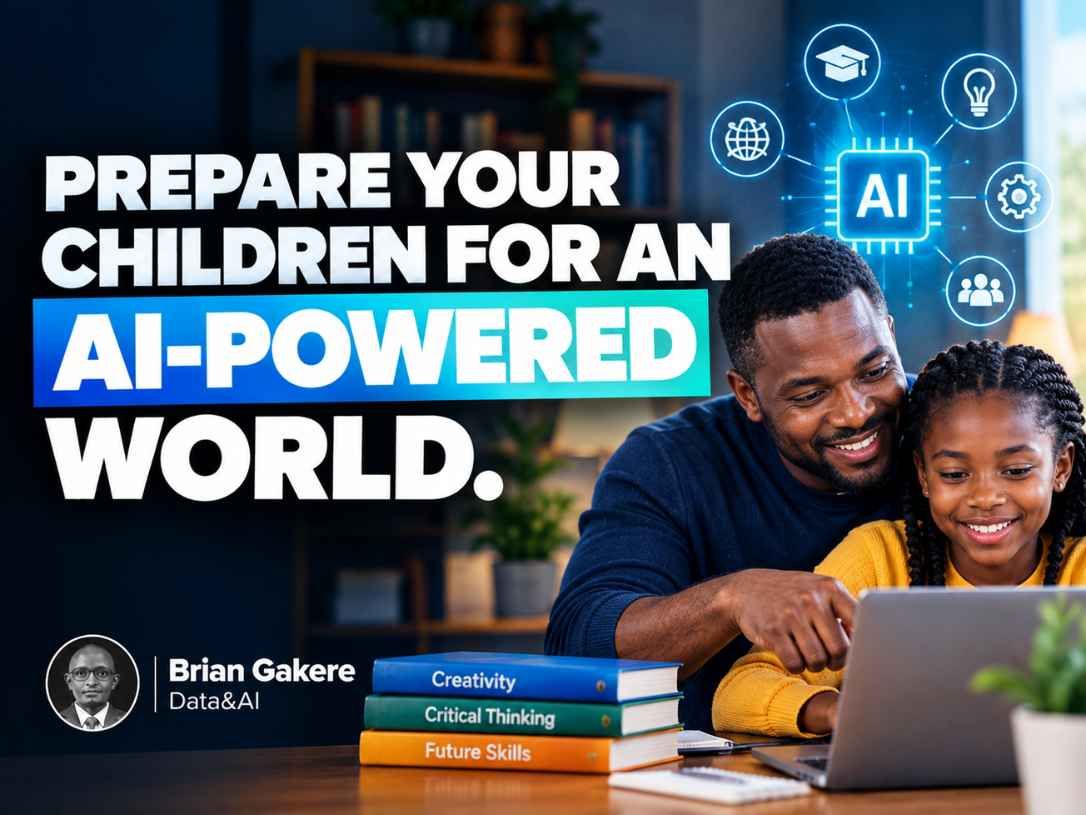
How African Parents Can Prepare Their Children for an AI-Powered World
Every generation of parents worries about what the future will look like for their children.
Today, one of the biggest changes is already here.
Artificial intelligence is becoming part of how people learn, work, communicate, create, and solve problems. Children growing up today will enter a world where AI is not a futuristic idea. It will simply be part of everyday life.
So what should African parents do to prepare their children?
I don't think the answer is to make every child an AI expert.
It is to help them develop the skills that will still matter when AI becomes even more capable.
Do not Just Teach Your Child to Use AI
Children will quickly learn how to open ChatGPT and ask questions.
The more important lesson is teaching them how to think before and after using it.
If a child asks AI a question, encourage them to ask:
Is this answer correct?
How can we verify it?
What evidence supports it?
Could there be another answer?
This turns AI from an answer machine into an opportunity to develop critical thinking.
Teach Them to Ask Better Questions
One of the most valuable skills in an AI-powered world may not be knowing all the answers.
It may be knowing what questions to ask.
A child who can clearly explain a problem, provide context, challenge an answer, and ask follow-up questions will get much more value from AI than someone who simply accepts the first response.
Parents can develop this skill without any special technology.
When your child asks you a question, don't always give them the answer immediately.
Ask:
"What do you think?"
"Why do you think that?"
"How could we find out?"
These simple habits build independent thinking.
Do not Let AI Replace Struggle
There is a temptation to use AI whenever something becomes difficult.
Homework is difficult? Ask AI.
Writing is difficult? Ask AI.
Research is difficult? Ask AI.
But some struggle is part of learning.
Children need opportunities to wrestle with difficult problems, make mistakes, change their minds, and eventually figure things out. AI should help them learn faster, not remove every challenge from learning.
Focus on Skills, Not Just Subjects
Parents naturally want their children to perform well in school. That still matters. But an AI-powered world will also require skills that go beyond remembering information. Children need to learn how to communicate clearly, solve problems, work with others, evaluate information, adapt to new tools, and think creatively. These skills can be developed through everyday activities.
Let children explain how something works.
Encourage them to build things.
Let them experiment.
Ask them to defend their ideas.
Give them problems without immediately giving them solutions.
The goal is to raise children who can think, not just children who can produce correct answers.
Teach Them That AI Can Be Wrong
One of the most important lessons parents can teach is simple:
AI is not always right.
AI can produce answers that sound confident and convincing while still being incorrect.
Children therefore need to understand that using AI also requires responsibility.
If something matters, verify it.
If an answer sounds strange, question it.
If AI provides information, look for reliable sources.
This is especially important as children increasingly use AI for schoolwork and research.
Give Them Access, But Give Them Guidance
Completely shielding children from AI may not prepare them for the world they will enter.
At the same time, giving children unlimited access without guidance isn't enough either.
Parents can create healthy boundaries around when and how AI is used.
For example, a child might first attempt a problem independently and then use AI to get an explanation or feedback.
The goal is not simply:
"Don't use AI."
It is:
"Use AI in a way that helps you become better."
Children Need to Build, Not Just Consume
There is another opportunity that I think parents should pay attention to.
AI is not only something children will consume.
They can also learn to create with it.
A child can use AI to build a simple project, explore an idea, create a story, analyze information, learn programming, or experiment with a business idea.
They don't need to become AI researchers.
They need to develop the confidence to ask:
"What can I create with these tools?"
That mindset can be powerful in a continent where young people will need to create new opportunities rather than simply wait for existing ones.
The Goal Is Not to Raise AI Experts
Parents do not need to understand every new AI model, application, or technology.
Technology will continue to change.
The deeper skills are more durable.
Teach your children to be curious.
Teach them to question.
Teach them to verify.
Teach them to solve problems.
Teach them to communicate.
Teach them to learn independently.
And teach them that technology is a tool, not a substitute for judgment.
The children growing up today will probably use AI in ways we cannot yet predict.
Our responsibility as parents is not to predict every technology they will encounter.
It is to prepare them to think clearly, learn continuously, and use whatever technology comes next wisely.
The future may be powered by AI. But our children still need to be powered by curiosity, judgment, and the ability to think for themselves.