The AI Business Case: When Should a Company Build, Buy or Simply Use an AI API?
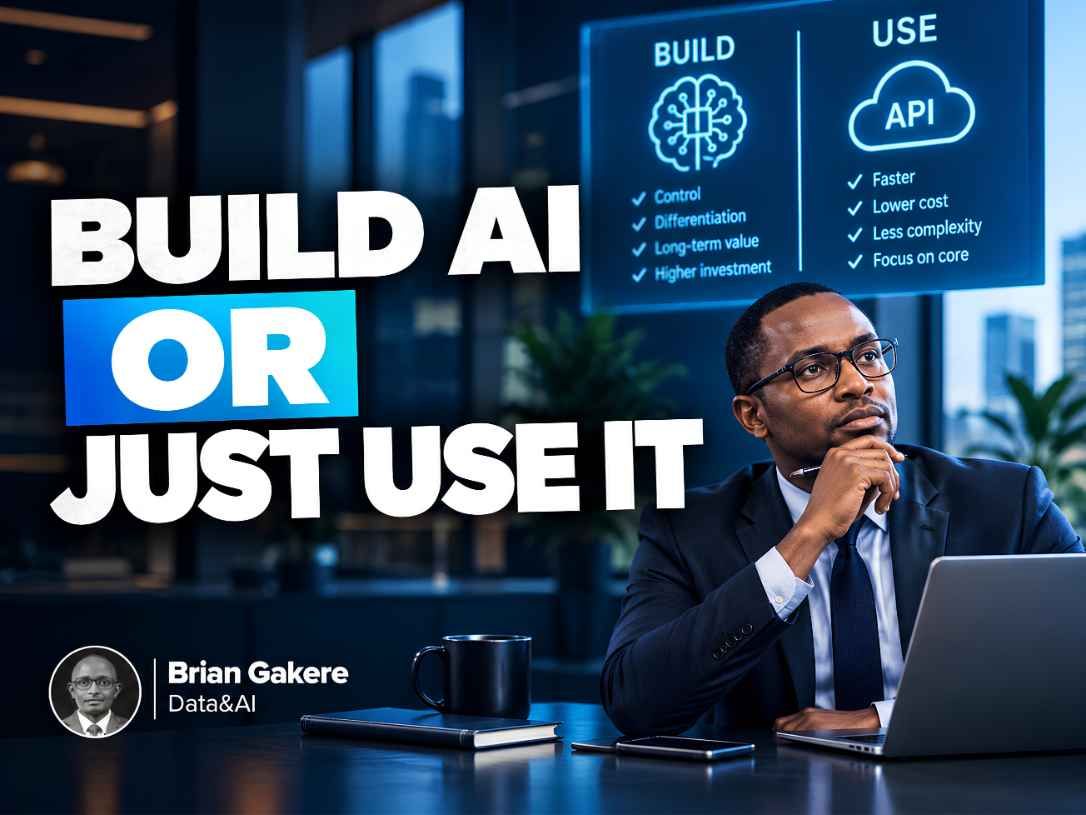
Once a company identifies a problem that AI could help solve, another question comes up:
Should we build it ourselves, buy an existing solution, or simply use an AI API?
This is where many businesses can overcomplicate things.
Because with AI, building something from scratch can feel more impressive.
But impressive doesn't always mean practical.
Start with the simplest option
Today, companies don't necessarily need to build their own AI models to create AI-powered products.
You can access powerful models through APIs and build applications around them.
This has significantly lowered the barrier to building AI applications. You don't necessarily need your own model, massive datasets or a team of machine-learning researchers to get started.
So the first question shouldn't be:
"Can we build this ourselves?"
It should be:
"What is the simplest way to solve this problem well?"
Option 1: Use an AI API
For many businesses, this is the natural place to start.
You can connect your application to an existing model through an API and test whether the idea actually works.
This allows you to move quickly without taking on the cost and complexity of training and maintaining your own model.
If you're still testing an idea, this can make a lot of sense.
Prove the use case before investing heavily in infrastructure.
Option 2: Buy an existing solution
Sometimes you don't need to build anything.
If an existing product already solves your problem well, buying or subscribing to it may be more practical.
For example, if you need AI-assisted customer support, document processing or meeting transcription, there may already be products designed specifically for that job.
Your competitive advantage doesn't necessarily come from owning the AI technology.
It may come from how you integrate it into your business and how well you solve your customers' problems.
Option 3: Build your own
Building more of the technology yourself can make sense when the business has a strong reason to do so.
Perhaps the existing solutions are too expensive at your scale.
Perhaps you need much more control.
Perhaps your requirements are highly specialized.
Or perhaps AI has become such an important part of your product that owning more of the stack makes economic or strategic sense.
But this is usually a decision you make after you've demonstrated that the use case works.
The progression can be quite different from traditional machine learning.
Instead of starting with data, training a model and then looking for a product, you can start with a product idea, test it using existing models, gather data and improve the system, and only later consider hosting or building more of the technology yourself if the economics and requirements justify it.
Don't build because you can
There is a temptation in technology to build everything ourselves.
It feels like greater control.
But building comes with costs:
- Development time
- Infrastructure
- Maintenance
- Talent
- Evaluation
- Updates
- Security and reliability
And AI systems can change quickly.
What makes sense today may not make sense six months from now.
So before building, ask whether the additional control is actually worth the additional cost and complexity.
A simple decision framework
When deciding what to do, start with these questions:
1. Are we still testing the idea? Start simple. An API or existing product may be enough.
2. Does an existing product solve the problem well? Consider buying rather than building.
3. Do we have requirements that existing solutions can't meet? Building more may make sense.
4. Is the cost of using an API becoming significant at our scale? Explore alternatives, including hosting or other models.
5. Is this technology itself our competitive advantage? If not, consider focusing your resources on the product and customer experience instead.
The answer doesn't have to be permanent.
You can start with an API today, improve the product, gather data and learn from real users, and make a different decision later.
Build less. Solve more.
I think this is one of the biggest opportunities AI gives businesses.
You don't always have to build the hardest part yourself.
You can take existing capabilities and combine them with good engineering, good product thinking and a deep understanding of your customers.
The goal isn't to own the most sophisticated AI stack.
The goal is to build something people actually need.
Start with the problem.
Use the simplest solution that works.
And only take on more complexity when the problem, and the economics, justify it.