Your Child Doesn't Need to Become an AI Engineer: But They Need AI Literacy
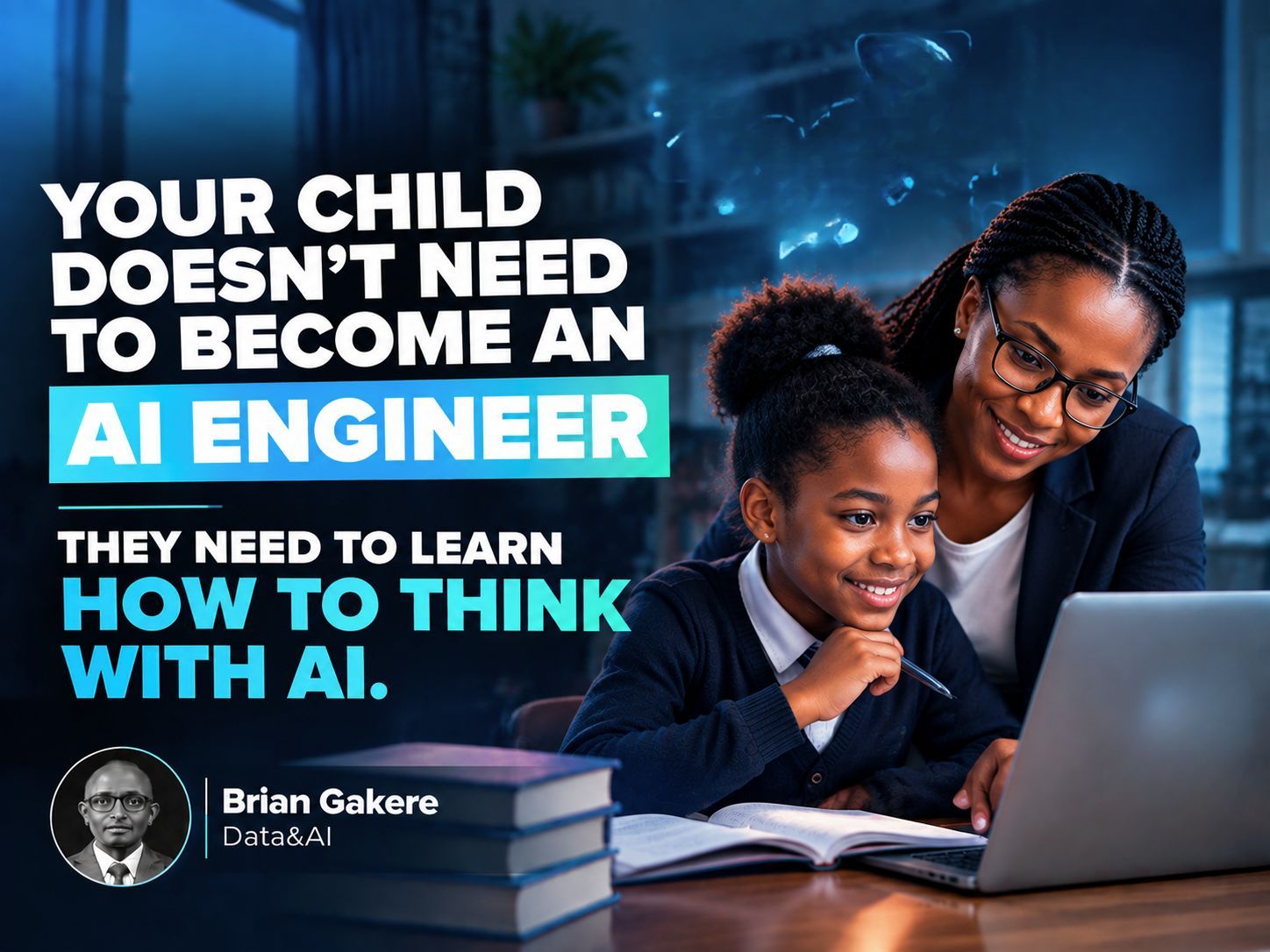
A few years ago, when parents thought about preparing their children for the future, the conversation was mostly about learning computers, coding, or digital skills.
Today, the conversation has changed.
Artificial Intelligence is becoming part of everyday life. Children are already interacting with AI through search engines, learning platforms, social media recommendations, and tools like ChatGPT. The question many parents ask is:
“Does my child need to learn how to build AI?”
The answer is no.
Not every child needs to become an AI engineer, just as not every child who uses a smartphone needs to become a phone developer.
But every child needs to understand how AI works, how to use it responsibly, and how to think critically about the information it provides.
This is what we call AI literacy.
AI Literacy Is Not About Building AI Models
When people hear “AI skills,” they often imagine advanced programming, mathematics, and computer science. Those skills are valuable for children who want to pursue careers in AI, but AI literacy is much broader.
AI literacy means understanding:
- What AI can and cannot do
- How to ask better questions
- How to evaluate AI-generated information
- How to use AI responsibly
- When human judgment is still necessary
A child does not need to know how to create ChatGPT. But they should understand that ChatGPT is not a person, it does not truly “think” like a human, and its answers should be questioned and verified.
The Future Belongs to Children Who Can Ask Better Questions
One of the biggest changes AI brings is that finding answers is becoming easier.
A child can ask AI to explain a scientific concept, summarize a book, or provide examples within seconds.
But the ability to find answers is only one part of learning.
The more important skill is knowing:
What questions should I ask?
AI makes information accessible, but curiosity, creativity, and critical thinking remain human skills.
A child who knows how to ask meaningful questions will get much more value from AI than a child who simply asks AI to complete tasks for them.
AI Should Strengthen Thinking, Not Replace It
The danger is not that children use AI.
The danger is that they use AI without thinking.
A student who asks ChatGPT to write every assignment may complete homework faster, but they may miss the opportunity to develop writing, reasoning, and problem-solving skills.
A student who uses AI to understand difficult concepts, receive feedback, practise skills, and explore ideas is building a stronger relationship with technology.
The difference is not the tool.
The difference is the mindset.
The Skills That Will Matter Even More in an AI World
As AI becomes more powerful, certain human skills become even more important.
Parents should encourage children to develop:
Curiosity — the desire to ask why and explore new ideas.
Critical thinking — the ability to question information instead of accepting everything immediately.
Communication — the ability to explain ideas clearly.
Creativity — the ability to imagine new solutions.
Problem-solving — the ability to understand challenges and find practical answers.
Domain knowledge — understanding subjects deeply enough to use AI effectively.
These skills will help children work alongside AI rather than compete against it.
What Should Parents Do?
Parents do not need to become AI experts before guiding their children.
Start with simple conversations:
Ask your child:
- “How did you use AI today?”
- “How do you know that answer is correct?”
- “Can you explain this in your own words?”
- “What would you do if AI gave you the wrong information?”
Teach children that AI is a powerful assistant, but they remain responsible for their learning and decisions.
Set boundaries around responsible use. Encourage honesty when AI is used for schoolwork. Teach them not to share private information online.
Most importantly, continue encouraging activities that develop independent thinking — reading, writing, discussions, experiments, creativity, and problem-solving without technology.
The Goal Is Not to Raise AI Engineers, it Is to Raise AI-Smart Humans
The future will not only belong to people who can build artificial intelligence. It will belong to people who know how to work with it wisely.
Some children will become AI engineers, researchers, and developers. Others will become doctors, teachers, entrepreneurs, lawyers, artists, and leaders who use AI in their fields.
Both groups will need the same foundation:
The ability to understand technology, question information, and use tools responsibly.
The question parents should ask is not:
“Will my child become an AI engineer?”
The better question is:
“Will my child know how to live, learn, and make decisions in an AI-powered world?”
Because in the future, AI literacy may become as important as digital literacy is today.